


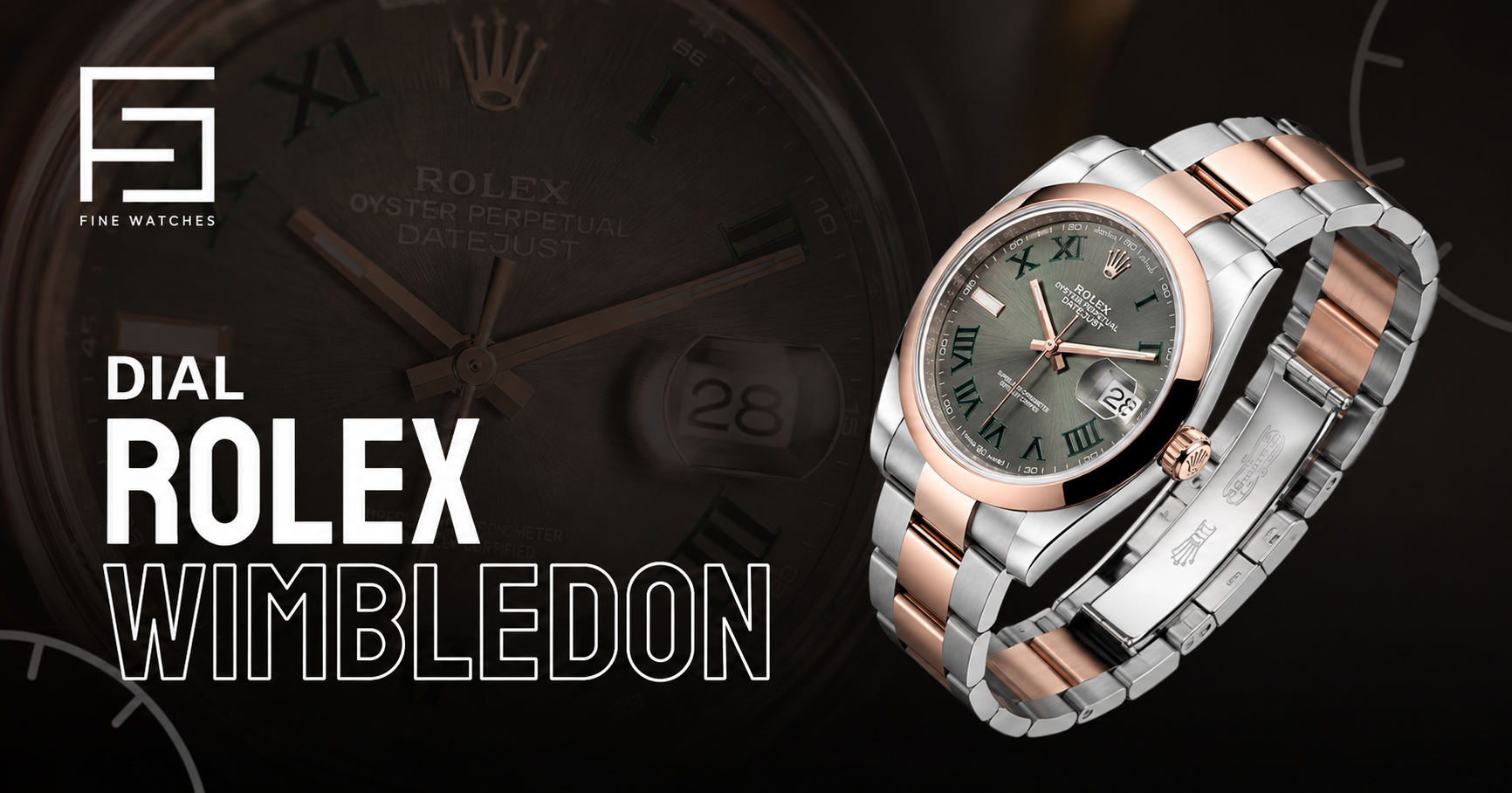
Have you ever spotted a watch across a room and instantly known its name? The Rolex Wimbledon Dial has that kind of presence. Its slate grey face and green Roman numerals stand out from every other Datejust. Yet Rolex has never once printed that name anywhere official. Collectors gave it that title, and it stuck for good reason. This guide covers the dial’s full history, every major reference, real prices and whether it makes a smart long-term buy.
What Is the Rolex Wimbledon Dial?
Why Collectors Call It the Wimbledon
Rolex never used the name “Wimbledon” in any official document. The nickname grew out of forums, dealers, and everyday collectors who noticed the dial’s green-outlined numerals and slate grey base. That color pairing reminded people of the grass courts and green branding at Wimbledon, so the name stuck. Decades later, even Rolex’s own retail partners use it freely in conversation.
Why This Datejust Is Different
Most Datejust dials use plain batons or diamonds. This one uses Roman numerals outlined in bright green, sitting on a grey background unlike anything else in the line. It reads as part sport watch, part dress watch, and that mix explains why it appeals to buyers who normally would not consider a Datejust at all.
The Complete History of the Rolex Wimbledon Dial
Rolex and Wimbledon Partnership Since 1978
Rolex became the Official Timekeeper of Wimbledon in 1978. That relationship remains active today and ranks among Rolex’s longest running sports partnerships. Green and white branding sits courtside every summer, and that visual language eventually found its way onto a watch dial, decades after the sponsorship itself began.
The First Wimbledon Datejust (2009)
The dial made its debut in 2009 on the Datejust II reference 116333. That watch used a two tone steel and yellow gold case, a fluted bezel, and an Oyster bracelet. The Roman numerals carried no lume at all, aside from a single luminous baton at 9 o’clock.
Evolution Through the Years
| Year | Model | What Changed |
| 2009 | Datejust II (ref. 116333) | Dial debuts, one configuration only |
| 2016 | Datejust 41 (ref. 126334, 126333) | Dial offered across steel, white and yellow Rolesor, new Calibre 3235 |
| Later years | Datejust 36 (ref. 126200, 126234) | Smaller case added, more references introduced |
Rolex expanded the dial’s availability because demand from collectors kept climbing every year, and offering it across more sizes and metals let more buyers actually get one.
Why Rolex Never Officially Named It Wimbledon
Where the Nickname Came From
The name spread through watch forums, secondhand dealers, and word of mouth among collectors long before mainstream media picked it up. No press release ever introduced it. It grew organically, the same way nicknames like “Pepsi” and “Batman” attached themselves to other Rolex dials.
Why Rolex Never Confirmed It
Rolex rarely gives nicknames to its own references, preferring plain descriptions like “black dial” or “slate dial” in official materials. That habit is deliberate. It keeps naming loose enough that the community, not the marketing department, decides what sticks. Despite that, dealers, auction houses, and even Rolex’s own boutique staff use “Wimbledon” without hesitation now.
Roger Federer and the Wimbledon Dial
Federer as a Rolex Testimonee
Roger Federer signed with Rolex in 2006 and became one of the brand’s most visible tennis ambassadors. His long association with grass court tennis made him a natural face for anything connected to Wimbledon, watch dial included.
Wimbledon Victories
Federer wore Rolex pieces during Wimbledon appearances and trophy celebrations throughout his career, reinforcing the mental link between his eight Wimbledon titles and the green and grey dial that shares the tournament’s nickname.
The Federer Effect
That association gave the dial a story buyers could point to, beyond just looking good. Collector demand climbed noticeably in the years after his most visible Wimbledon wins, and that demand has stuck around even after his retirement in 2022.
Current Tennis Stars Wearing Rolex
Rolex runs an active Testimonee program that keeps the tennis connection alive well past Federer’s playing days.
- Jannik Sinner: The 2025 Wimbledon gentlemen’s singles champion, he opened Centre Court play in 2026 as a Rolex Testimonee.
- Iga Swiatek: The reigning Wimbledon women’s champion holds the same Testimonee title as Sinner.
- Carlos Alcaraz: A multiple Grand Slam winner and long time Rolex Testimonee representing the men’s tour.
- Coco Gauff: A Roland Garros champion and one of the most visible young stars in the Testimonee roster.
- Taylor Fritz and Ben Shelton: Both American stars competing on tour as active Rolex Testimonees.
- Mirra Andreeva: A rising star added to the roster as part of tennis’s next generation.
- Legends Bjorn Borg, Rod Laver and Chris Evert: Long standing Testimonees who represent the brand’s decades long tennis history.
Rolex Testimonees represent the brand at Grand Slam events without formally endorsing specific watch models. Even so, the tennis connection keeps the Wimbledon dial’s story current every single season.
Rolex Wimbledon Dial Design Explained
Slate Grey Sunray Dial
The base dial uses a sunray finish, meaning brushed lines radiate out from the center. Under direct light, the grey shifts subtly between lighter and darker tones, giving the dial visible depth instead of a flat, single color surface.
Green Outlined Roman Numerals
Black enamel numerals get a thin green outline applied by hand during production. That detail is what actually earns the dial its nickname, since the green outline is the direct visual nod to Wimbledon’s grass courts and signage.
The Famous 9 O’Clock Baton Marker
Every Wimbledon dial carries Chromalight lume only at the hands and one baton marker positioned at 9 o’clock. Collectors debate this choice constantly, since it breaks the dial’s otherwise clean symmetry and leaves the Roman numerals dark at night.
Complete Technical Specifications
| Spec | Datejust 41 (Wimbledon) | Datejust 36 (Wimbledon) |
| Case Size | 41mm | 36mm |
| Movement | Calibre 3235 | Calibre 3235 |
| Crystal | Sapphire, scratch-resistant | Sapphire, scratch resistant |
| Water Resistance | 100 meters | 100 meters |
| Power Reserve | Approximately 70 hours | Approximately 70 hours |
| Accuracy | Minus 2 to plus 2 sec/day | Minus 2 to plus 2 sec/day |
| Bracelet | Oyster or Jubilee | Oyster or Jubilee |
| Bezel | Fluted or smooth | Fluted or smooth |
| Dial | Slate grey, green Roman numerals | Slate grey, green Roman numerals |
| Lume | Chromalight, hands and 9 o’clock only | Chromalight, hands and 9 o’clock only |
| Certification | Superlative Chronometer | Superlative Chronometer |
Older Datejust II models ran the Calibre 3136, while the original 36mm Datejust used the Calibre 3135. Both were replaced by the 3235 once Rolex updated the whole collection.
Rolex Wimbledon References Explained
Rolex 116333
The original 2009 reference. 41mm Datejust II, two tone steel and yellow gold, fluted bezel, Oyster bracelet, Calibre 3136 movement. Discontinued in 2016, now a discontinued collector’s piece.
Rolex 116334
A close cousin from the same era, steel with a white gold fluted bezel. Some 116334 dials carry the true Wimbledon look, while others use plain black numerals without the green outline.
Rolex 126300
Steel 41mm Datejust with a smooth bezel, launched in 2016. Offered with a Wimbledon dial option alongside many other dial choices, running the newer Calibre 3235.
Rolex 126334
Steel and white gold 41mm, fluted bezel, one of the most requested Wimbledon references today thanks to its balance of size, bezel style, and metal contrast.
Rolex 126333
Steel and yellow gold 41mm, fluted bezel, Jubilee or Oyster bracelet options. A warmer toned alternative to the white gold 126334.
Rolex 126331
Steel and rose gold Everose Rolesor, 41mm, fluted bezel. The rarest metal pairing for the Wimbledon dial, and the priciest at retail.
Rolex 126200
The smooth bezel 36mm option, steel only, on an Oyster bracelet. A practical daily wear pick for smaller wrists.
Rolex 126234
White gold fluted bezel, 36mm, steel case. Pairs a smaller size with a dressier bezel finish.
Rolex Wimbledon Sizes
36mm
Best for smaller wrists or buyers who want a vintage-inspired proportion. Pros include easier daily wear and a lower entry price. The main drawback is a smaller canvas for the green numerals to stand out on.
41mm
Best for buyers who want a bolder, more modern look. Pros include better wrist presence and access to more reference options. The tradeoff is a heavier feel for smaller wrists over a full day.
| Factor | 36mm | 41mm |
| Best For | Smaller wrists, classic proportions | Larger wrists, modern sizing |
| Starting Retail | Around $8,150 | Around $8,950 |
| Reference Count | Fewer available | More available |
Metal Options Explained
Oystersteel
The most affordable and most durable option, resistant to scratches and everyday wear. Popular for buyers who want a Wimbledon dial they can wear daily without worry.
White Rolesor
Steel paired with an 18k white gold fluted bezel. Adds a cooler, brighter contrast against the slate grey dial and green numerals.
Yellow Rolesor
Steel paired with 18k yellow gold. The original 2009 combination, still popular for buyers who want a warmer, more traditional Rolex look.
Everose Rolesor
Steel paired with Rolex’s proprietary rose gold alloy. The rarest and most expensive metal option, appealing to buyers who want something less common.
Bracelet and Bezel Options
| Option | Look | Best For |
| Jubilee Bracelet | Five link, dressier | Buyers who want a classic Datejust feel |
| Oyster Bracelet | Three link, sportier | Buyers who want durability and daily wear comfort |
Fluted Bezel
A rigid gold bezel that adds a dressier, more traditional finish. The most common bezel choice among Wimbledon dial buyers.
Smooth Bezel
A plain polished bezel that leans sportier and pairs well with the steel-only 126300 reference.
Fluted bezel and Jubilee bracelet remain the single most requested combination among Wimbledon dial buyers today.
Movement Inside the Wimbledon Datejust
Calibre 3235
Runs a 70-hour power reserve, the Chronergy escapement for better efficiency, and carries Superlative Chronometer certification at minus 2 to plus 2 seconds per day.
Older Calibre 3136
Powered the original Datejust II Wimbledon references, offering roughly 48 hours of power reserve, well short of the newer movement.
Older Calibre 3135
Powered early 36mm Datejust models before the Calibre 3235 replaced it across the collection starting in 2015 and 2016.
| Movement | Power Reserve | Used In |
| Calibre 3235 | ~70 hours | Current Datejust 41 and 36 |
| Calibre 3136 | ~48 hours | Datejust II (2009-2016) |
| Calibre 3135 | ~48 hours | Older 36mm Datejust models |
Why the Wimbledon Dial Is So Popular
The tennis connection gives it a story most dials do not have. Rolex’s own reputation for reliability adds confidence to the purchase. Federer’s history with the brand still drives interest years after his retirement. The green and grey color combination stands out instantly, even from across a room, which makes the watch easy to recognize and easy to talk about.
Why Some Collectors Do Not Like It
The 9 O’Clock Baton Debate
Some buyers find the single lume marker at 9 o’clock distracting, since it breaks the dial’s symmetry and leaves every other numeral dark at night.
Roman Numeral Symmetry
Purists sometimes prefer dials with matching markers all the way around, and the mixed numeral and baton layout does not suit every taste.
Too Popular?
A small group of collectors avoid the dial simply because it has become so recognizable, preferring rarer or less talked about Datejust configurations instead.
Rolex Wimbledon vs Standard Datejust
| Factor | Wimbledon Dial | Standard Datejust Dial |
| Dial Color | Slate grey with green outline | Black, white, silver, blue, and more |
| Lume | Hands and 9 o’clock only | Full lume on most standard dials |
| Recognition | Instantly recognizable | Varies by color |
| Resale Demand | Consistently strong | Varies by dial and reference |
| Versatility | Sport meets dress | Depends on chosen dial |
Rolex Wimbledon vs Other Famous Rolex Dials
Blue Dial
Offers a cooler, more corporate look, popular for office wear, without the sporty story the Wimbledon dial carries.
Black Dial
The most universally versatile option, but far less distinctive on the wrist compared to the green and grey combination.
Mint Green Dial
A newer, brighter alternative that appeals to buyers who want green tones without the vintage tennis connection.
Silver Dial
A classic, understated choice, better suited to buyers who prefer a quieter, low-key Datejust.
Champagne Dial
Warmer and softer looking, better paired with yellow or rose gold cases than the Wimbledon’s grey and green palette.
Buyers chasing a conversation-starting piece usually land on the Wimbledon dial, while buyers wanting something quieter tend to pick black, silver, or champagne instead.
Rolex Wimbledon Prices (2026)
Retail Prices
Official retail starts around $8,150 for the 36mm steel version and climbs past $17,000 for 41mm Rolesor models with a fluted bezel, depending on metal choice.
Secondary Market Prices
Pre-owned examples typically trade a bit above retail rather than at the steep premiums seen on sport models like the Daytona. Waitlists at authorized dealers push many buyers toward the pre-owned market instead.
| Reference | Size | Metal | Approx. Retail | Approx. Pre-Owned |
| 126200 | 36mm | Steel | $8,150 | $8,500-$9,500 |
| 126234 | 36mm | White Rolesor | $12,700 | $13,000-$14,500 |
| 126300 | 41mm | Steel | $8,950 | $9,500-$10,500 |
| 126334 | 41mm | White Rolesor | $14,800 | $15,500-$17,000 |
| 126333 | 41mm | Yellow Rolesor | $14,800 | $15,500-$17,000 |
| 126331 | 41mm | Everose Rolesor | $17,300 | $18,000-$19,500 |
Prices shift with market demand, so treat these as a general range rather than a fixed number.
Is the Rolex Wimbledon a Good Investment?
Market Performance
The dial has held steady demand for over a decade, without the sharp price swings seen in some hyped sport models.
Value Retention
Most examples trade above retail on the secondary market, though gains stay modest compared to something like a steel Daytona.
Demand vs Supply
Authorized dealer waitlists persist, particularly for white gold fluted bezel models, keeping demand ahead of easy retail supply.
Long Term Outlook
The Federer connection and ongoing Wimbledon partnership give the dial a story that should keep it relevant for years to come.
Who Should Buy for Investment
Buyers looking for steady, modest appreciation rather than a fast flip are the best fit for this dial, not short-term speculators.
Buying New vs Buying Pre-Owned
Buying new means paying retail, but usually requires joining a waitlist first, sometimes for a year or more depending on the reference. Buying pre-owned means paying a bit more than retail, but getting the watch immediately, along with the ability to inspect the exact piece before purchase. Certified pre-owned dealers add authentication and a warranty, closing much of the gap in buyer confidence between new and used.
How to Authenticate a Rolex Wimbledon
- Serial Number: Confirm it matches Rolex’s known production ranges for the reference in question.
- Dial Details: Check the green outline color and font weight against verified reference photos.
- Movement: Confirm the Calibre matches the year and reference, since mismatches signal a problem.
- Bracelet: Check end link fit and clasp engravings for consistency with the case.
- Crown: Confirm the crown logo depth and placement match genuine examples.
- Papers: Ask for the original warranty card whenever possible.
- Box: A matching box adds confidence but is not required for authenticity.
- Service History: Ask if the watch has been serviced, and by whom.
Best Rolex Wimbledon Configuration to Buy
Best Budget: 36mm steel ref. 126200 with a smooth bezel and Oyster bracelet. Best Daily Wear: 41mm steel ref. 126300, smooth bezel, Oyster bracelet. Best Investment: 41mm white Rolesor ref. 126334, fluted bezel, Jubilee bracelet. Best Collector Choice: Discontinued ref. 116333 Datejust II, for its place in the dial’s history. Best Luxury Option: 41mm Everose Rolesor ref. 126331, fluted bezel.
Common Mistakes Buyers Make
- Paying Too Much: Skipping price comparison across multiple dealers before committing.
- Buying the Wrong Reference: Confusing a “black Wimbledon” lookalike for the genuine green outline dial.
- Ignoring Condition: Overlooking case wear or bracelet stretch that affects resale value later.
- Missing Paperwork: Buying without a warranty card or service records when they were available.
- Buying Fakes: Purchasing from unverified sellers offering prices far below market.
- Choosing the Wrong Size: Picking 41mm without trying it on first, only to find it wears too large.
Care and Maintenance Tips
Clean the case and bracelet with a soft cloth and mild soapy water, avoiding harsh chemicals. Store the watch in a dry place, away from direct sunlight, when not being worn. Rolex recommends servicing roughly every 10 years, though earlier servicing may be needed with heavy daily wear. Avoid exposing the watch to extreme temperature changes. Rinse after exposure to salt water or chlorine, since both can affect the bracelet finish over time.
Conclusion
The Rolex Wimbledon Dial earns its reputation through more than just good looks. It carries a real 1978 sports partnership, a design that has evolved carefully since 2009, and a Federer connection that still resonates with buyers today. Whether you choose a 36mm steel piece for daily wear or a 41mm Rolesor version for something bolder, understanding the references, real pricing, and authentication steps puts you in a stronger position before you buy. Choose the configuration that fits your wrist, budget, and style, then buy from a dealer that authenticates every piece before it reaches you.
 Rolex
Rolex Cartier
 Patek Philippe
 Audemars Piguet
 Vacheron
 Breitling
 Omega
Omega IWC
IWC Hublot
 Panerai
 Tudor
Tudor Ulysse Nardin
 Bvlgari
 Hermes
 Chanel
 Jaeger-lecoultre
 De Grisogono
 Chopard
 Zenith
 Christian Dior
 Louis Vuitton
 Baume & Mercier
 Breguet
 Fendi
Fendi Gucci
Gucci Roger Dubuis
 Tiffany & Co.
 Michele
 Montblanc
 Gerald Genta
 Richard Mille
 Blancpain
 Powered by