



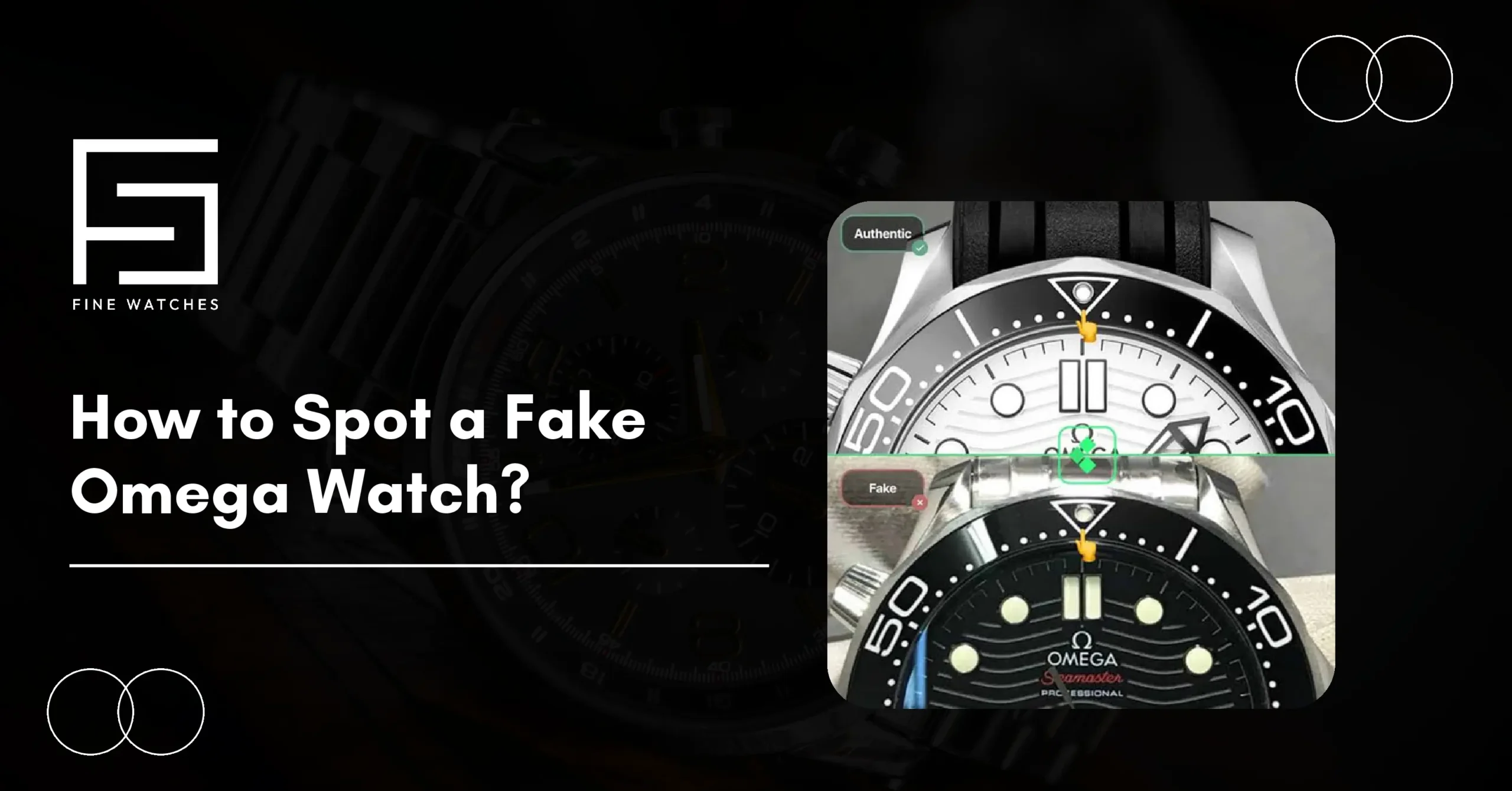
You spot a fake Omega watch by checking five things: the logo, the dial print, the serial number, the movement, and the weight. A real Omega gets these details right every time. A fake gets at least one wrong. Omega sits near the top of every counterfeiter’s list, right behind Rolex. The Seamaster and Speedmaster draw the heaviest fake production because buyers want them so badly.
If you plan to buy a used Omega in Houston or online, you want to know how to spot fake Omega Watch. This guide walks you through each check step by step, in plain language, with no watchmaking degree required. You will also learn where to get a professional Omega authenticity check in Houston if you want a second opinion before you buy.
How To Spot Fake Omega Watch?
Fake Omega watches cost buyers thousands of dollars each year. Some fakes look sharp in photos. A seller on a resale site, at a flea market, or even at a pawn shop will not tell you the watch is fake. You have to check it yourself, or bring it to a watch expert. Rolex fakes often get caught fast because so many buyers already know the common signs to look for. Omega fakes slip past more buyers because fewer people study the brand closely, and counterfeiters know it.
Learning how to spot a fake Omega watch puts you ahead of most buyers in the resale market. Price offers an early clue too. A real Seamaster or Speedmaster holds strong resale value because demand stays high and supply stays limited. A listing priced far below market value is a signal, not a bargain.
Check the Omega Logo First
The Omega logo gives you one of the fastest ways to catch a fake. Look at the case back, the dial, and the crown. On a real Omega, the omega symbol holds even, rounded curves. The metal edges stay sharp and clean under a loupe. Fake logos often look slightly squashed, or the curves sit uneven on one side. Check the crown too. Real Omega crowns carry a deep, precise stamp of the logo.
Cheap fakes use a shallow, blurry stamp, and it wears off within months of regular wear. The dial text deserves a close look as well. Real Omega dials print small text in crisp, even letters, with consistent spacing around the word Omega and the model name. Fake dials often show letters set too close together, or a font slightly off from the real one.
Real vs Fake Omega Seamaster: What Changes
The Seamaster ranks as Omega’s best selling line, and also its most copied. A real vs fake Omega Seamaster comparison usually comes down to three spots. First, check the wave pattern on the dial. Real Seamaster dials carry a tight, even wave texture, pressed with precision tools. Fakes often show a rough, inconsistent wave, or a printed pattern instead of a pressed one.
Second, check the helium escape valve on dive models. Real valves sit flush and turn smoothly. Fake valves often stick out at an odd angle or feel loose under light pressure. Third, check the date window. Real Omega date windows sit level with the dial, with slight magnification from the cyclops lens on select models. Fake date windows often sit crooked or show a blurry, hard to read number.
Fake Omega Speedmaster Tells You Should Not Miss
The Speedmaster, known for its role in NASA missions, draws heavy counterfeit attention. A few fake Omega Speedmaster tells stand out fast once you know where to look. Check the tachymeter bezel first. Real Speedmaster bezels show crisp, deep engraving with even spacing between numbers. Fake bezels often show shallow, uneven engraving, or numbers that drift out of alignment near the 12 mark.
Check the chronograph pushers next. Real pushers feel firm and click with a sharp, clean response. Fake pushers often feel mushy, or they stick when pressed down. Check the caseback engraving too. Real Speedmaster casebacks list exact model references and production details in clean, readable text. Fakes often blur small text or misspell technical terms found on a genuine piece.
How to Authenticate Omega Watch Serial Numbers?
An Omega serial number lookup gives you one of the strongest ways to authenticate a watch. Every real Omega carries a unique serial number stamped inside the case back and, on many models, engraved between the lugs.
Here is how to authenticate an Omega watch using its serial number:
-
- Find the serial number engraved between the lugs, or printed on the movement itself.
- Compare the number format to the watch’s stated production year. Omega serial numbers follow a known sequence tied to specific date ranges.
- Contact an authorized Omega dealer or a trusted watch expert to confirm the number matches Omega’s records.
- Watch for numbers that look re-engraved, shallow, or spaced unevenly. Fakes often reuse a stolen serial number or stamp one outside Omega’s known ranges.
A missing serial number, or one that looks freshly scratched in, stands out as a warning sign on its own. Sellers who refuse to show you the serial number deserve extra suspicion.
Omega Movement Check: The Inside Story
The movement is the engine inside the watch, and it tells you the truth fast. Open the case back, if the watch allows it, or ask a watchmaker to check it for you. Real Omega movements show clean finishing, with polished edges and evenly spaced jewels. Many modern models use the Co-Axial escapement, a design Omega patented and uses across most of its current lineup.
A fake movement often skips this feature entirely, or copies it poorly, with rough, visible tool marks around the edges. Weight matters here too. Real Omega movements use dense, precise components built to close tolerances.
A fake movement often feels lighter, and the second hand sweep looks jerky instead of smooth and even. Listen to the ticking as well. A real Omega automatic movement runs quietly, with a soft, steady sound. A loud, uneven tick often points to a cheap quartz substitute hidden inside a fake case.
Weight, Case Back, and Other Physical Checks
Weight tells you a lot before you check anything else. Real Omega watches use solid stainless steel, gold, or titanium. Fakes often use lightweight alloys to cut cost, so the watch feels hollow in your hand. Check the case back next. Real Omega case backs screw on with tight, even threads and sit flush against the case. Fake case backs often sit slightly crooked, or the threads feel gritty when you twist them.
Check the sapphire crystal too. Real Omega crystals resist scratches from a fingernail test. Fake crystals, often made from mineral glass or plastic, scratch far more easily under the same test. Check the bracelet clasp last. Real Omega clasps close with a firm, solid click and show the logo stamped with sharp detail. Fake clasps often feel loose, or the stamp looks worn even on a supposedly new watch.
Box, Papers, and Purchase History
A real Omega often comes with a box, warranty card, and purchase receipt, though a missing box does not always mean a fake. Still, these items add weight to your authenticity check. Look at the warranty card closely.
Real Omega warranty cards use specific fonts, hologram stickers, and a printed serial number that matches the watch. Fake cards often show a blurry hologram or a serial number that does not line up with the one on the case. Ask the seller where the watch came from. A clear purchase history, with a receipt from an authorized dealer, gives you more confidence than a vague story about a family member or an online deal.
Where to Get Omega Authentication in Houston?
You have gone through several checks now: logo, dial, serial number, movement, weight, and paperwork. If any of these raised a doubt, stop before you buy. FS Fine Watches offers Omega authentication in Houston, backed by watchmakers who inspect Seamaster, Speedmaster, and every other Omega model under a loupe and on the timing machine on a regular basis.
Bring your watch in before you buy, or right after, and get a clear answer instead of a guess. A professional check takes minutes and saves you from a costly mistake. Visit FS Fine Watches in Houston for a full Omega authenticity check before your purchase becomes final, and buy with real confidence instead of hope.
Final Check Before You Buy
Buying a used Omega always carries risk, but you reduce it with the right checks. Look closely at the logo, the dial, the serial number, the movement, and the weight before you buy. If you still feel unsure after these checks, bring the watch to FS Fine Watches. Our Houston showroom offers a hands-on Omega authenticity check so you buy with confidence, not doubt.
 Rolex
Rolex Cartier
 Patek Philippe
 Audemars Piguet
 Vacheron
 Breitling
 Omega
Omega IWC
IWC Hublot
 Panerai
 Tudor
Tudor Ulysse Nardin
 Bvlgari
 Hermes
 Chanel
 Jaeger-lecoultre
 De Grisogono
 Chopard
 Zenith
 Christian Dior
 Louis Vuitton
 Baume & Mercier
 Breguet
 Gucci
Gucci Roger Dubuis
 Tiffany & Co.
 Michele
 Gerald Genta
 Richard Mille
 Blancpain
 Powered by