


How to Check If a Patek Philippe Watch Is Real: A Step-by-Step Authenticity Guide

How to Tell If a Patek Philippe Is Real: A Step-by-Step Authentication Guide
Patek Philippe produces roughly 60,000 watches per year. The counterfeit watch market produces millions. That gap tells you something important about the authentication challenge you are facing.
The good news is that genuine Patek Philippe watches are made to a standard so high that counterfeits, even sophisticated ones, consistently fail when examined carefully. The finishing, the movement quality, the documentation, and the tactile feel of a real Patek Philippe are genuinely difficult to replicate at the price points at which fakes are sold.
This guide walks through exactly how to tell if a Patek Philippe is real, covering every checkpoint from initial visual inspection through movement examination, serial number verification, and documentation review. Whether you are buying a Nautilus, a Calatrava, an Aquanaut, or a complicated dress watch, these checks apply across the entire collection.
What You Need Before You Start
Authenticating a Patek Philippe properly requires a few basic tools. None of them are expensive, and most buyers either already have them or can acquire them easily.
A 10x jeweler’s loupe is the most important. A significant portion of authentication work happens at magnification levels your naked eye cannot achieve. The dial printing, case engravings, movement finishing, and hallmarks on a genuine Patek Philippe are executed at a level of precision that only becomes fully visible under magnification, and that same magnification reveals the shortcuts that counterfeit manufacturers take.
A macro camera lens for your phone works as a reasonable substitute if you do not have a loupe, though the loupe gives better control over focus and lighting angle. A small flashlight helps reveal finishing details that change under different light directions. A jeweler’s scale is useful for checking weight against published specifications for the reference you are examining.
Step 1: Request the Right Information Upfront
If you are buying from a remote seller or examining a watch before a meeting, the information a seller provides before you even see the watch tells you a great deal.
Request clear, high-resolution photographs of the dial, the case sides and lugs, the crown, the caseback engravings, the clasp, and if possible the movement. Ask for a short video of the watch running, showing the seconds hand in motion and the crown being wound and set through its positions.
A seller with a genuine Patek Philippe has nothing to gain from refusing these requests. Every legitimate watch comes with a story: where it was purchased, who owned it, whether it has been serviced, and what documentation accompanies it. A seller who is vague, evasive, or slow to provide this information before you have committed to anything is showing you something important about the transaction.
Step 2: Examine the Dial Under Magnification
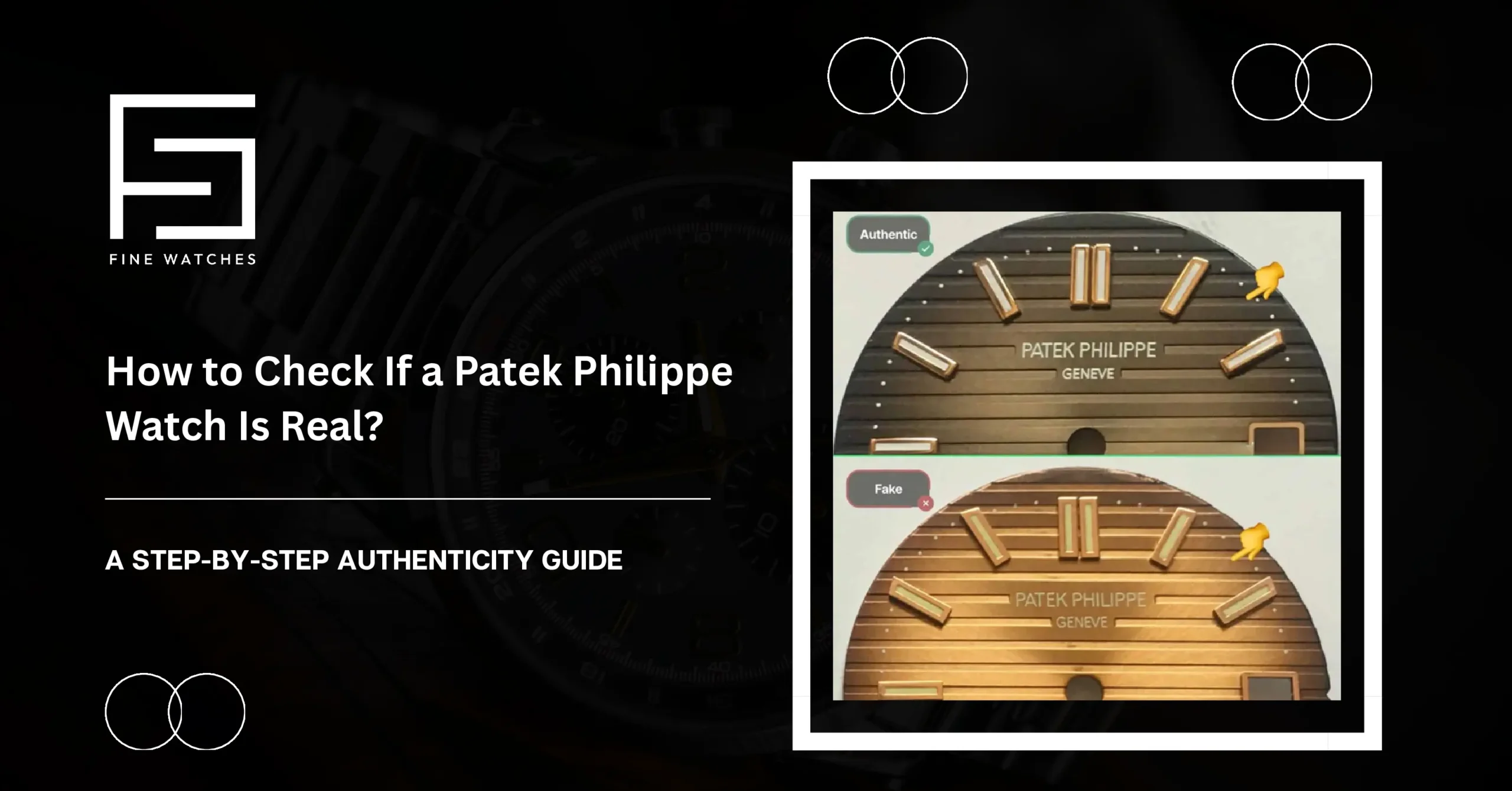
The dial of a genuine Patek Philippe is one of the most revealing authentication points because the manufacturing standards are exceptionally high and the details are very difficult to replicate convincingly.
Dial printing quality. Every word, numeral, and marking on a genuine Patek Philippe dial is printed with absolute precision. “Patek Philippe” and “Geneve” appear in crisp, consistently weighted characters with no bleeding at the edges under a loupe. The minute track around the perimeter is evenly spaced with perfectly uniform line widths throughout. Counterfeit dials show slightly uneven character weights, minute printing that bleeds or softens at the edges, or spacing inconsistencies that become obvious under magnification.
The Calatrava cross. On many Patek Philippe models, the Calatrava cross logo appears on the dial or crown. On genuine watches, this logo is precisely rendered with sharp angles and clean edges. Counterfeit versions show slightly rounded corners, uneven arm widths, or a softness in the logo that becomes clear under a loupe.
Applied indices and hour markers. On dress models and sports watches alike, Patek Philippe’s applied hour markers are set with absolute consistency. Each marker sits flush with the dial surface, shows no visible adhesive at the base, and has a consistent finish across all positions. Under magnification, the edges of genuine applied markers are clean and sharp. Counterfeit markers frequently show slight height variations between positions, visible adhesive residue, or a slightly different surface quality from one marker to the next.
Hand finishing. Genuine Patek Philippe hands are shaped and finished to a standard that is immediately apparent under magnification. The beveled edges of the hands are angled, meaning they are polished to a mirror finish at the edge where they meet the flat surface. The lume application on luminous models is clean, even, and contained precisely within the lume plots with no overflow. Counterfeit hands show rough edges, uneven lume application, or angling that is present but poorly executed with visible tool marks.
Step 3: Inspect the Case, Crown, and Hallmarks
Patek Philippe cases are machined and finished to genuinely exceptional tolerances. The combination of brushed and polished surfaces on any given case meets in perfectly defined transitions that require extremely precise manufacturing to achieve.
Surface finishing transitions. On a genuine Patek Philippe, the line where a brushed surface meets a polished surface is razor clean. Run your fingernail very gently along this transition on the case. On a genuine watch, you feel the texture change immediately at a precise point. On counterfeits, this transition is slightly blurred, or the brushing direction is inconsistent in a way that becomes visible under angled light.
Metal hallmarks. Genuine Patek Philippe cases in 18k gold, white gold, or platinum carry the appropriate Swiss assay hallmarks and fineness stamps. In yellow gold, look for the 750 stamp indicating 18 karat gold content. These stamps on a genuine watch are deeply and cleanly struck with sharp edges. Counterfeit hallmarks are typically shallower, less defined, or positioned slightly differently than the genuine specification for that reference.
The Calatrava cross on the crown. The crown of a genuine Patek Philippe carries the Calatrava cross engraved or applied with clean, precise lines. Under a loupe, the cross on a genuine watch has sharp angles and consistent line widths. The machining around the crown tube is smooth and precise. Any roughness, softness in the engraving, or inconsistency in the crown finishing is a significant red flag.
The caseback. On the display caseback models, the movement is visible through a sapphire crystal. Examine the movement finishing through the caseback before the caseback is opened. The quality of what you see tells you immediately whether the movement inside is genuine. On solid casebacks, the engravings for the serial number, reference number, and other markings should be deeply and precisely struck. Genuine engravings have sharp edges and consistent depth across every character.
Step 4: Examine the Bracelet and Clasp
The bracelet and clasp on a genuine Patek Philippe are manufactured to the same standard as the case. This is an area where counterfeit manufacturers frequently cut corners because the tooling required to replicate Patek Philippe’s bracelet construction accurately is expensive.
On integrated bracelets like the Nautilus and Aquanaut, the finishing on the links should match the case finishing in both quality and character. Polished surfaces are mirror sharp. Brushed surfaces have consistent grain direction across all links. The link articulation feels smooth and weighted, with each link contributing equally to the bracelet’s flexibility.
The clasp on a genuine Patek Philippe deploys with a positive, solid click and carries the appropriate reference stamps and Patek Philippe markings on the interior surface. These markings are clean and precisely applied. The clasp should hold firmly when closed with no visible gap or play. Counterfeit clasps frequently rattle slightly when closed, show a visible gap at one side, or have markings that are shallower and less defined than the genuine article.
Step 5: Verify the Movement
The movement inside a genuine Patek Philippe is one of the most reliable authentication points and one of the hardest things for counterfeit manufacturers to replicate convincingly. Patek Philippe’s calibers are finished to a standard that reflects the company’s 185-year history of movement making.
Request that the caseback be opened by a qualified watchmaker for in-person inspections. For remote purchases, request clear movement photographs at multiple angles.
What a genuine Patek Philippe movement looks like. The bridges and plates on a genuine Patek movement show Cotes de Geneve striping, also called Geneva stripes, applied with perfect consistency. The flat surfaces between the stripes are polished to a mirror finish. The beveled edges of every bridge and plate are angled to a mirror finish with sharp, clean transitions. Every screw head is polished mirror-bright with a single, centered slot. Every jewel is set precisely in its chatons with no visible roughness at the settings.
Perlage, a circular graining technique, is applied to the undersides of plates and other surfaces that face inward. On a genuine movement, this perlage is applied with consistent circle size and spacing across the entire surface.
Movement serial number. The serial number on the movement must match the serial number on the case and on any accompanying paperwork. Mismatched serial numbers indicate that the movement has been replaced with a non-genuine caliber or that components from multiple watches have been combined. Either situation significantly affects both authenticity and value.
The winding and setting feel. This is subjective until you have handled genuine Patek Philippe watches, but experienced buyers consistently describe the winding and setting feel of a genuine Patek as noticeably superior to any counterfeit. The crown winds with a smooth, consistent resistance that builds evenly. The setting positions engage with a precise, clean feel. Counterfeits feel looser, grittier, or less controlled through the same actions.
Step 6: Check Serial Numbers, Paperwork, and Provenance
Every genuine Patek Philippe has a unique serial number that corresponds to a specific production year and can be used to verify the watch’s history directly with Patek Philippe.
Where to find the serial and reference numbers. On most Patek Philippe models, the serial number is engraved between the lugs at the 6 o’clock position or on the caseback. The reference number identifying the model is typically between the lugs at the 12 o’clock position. On some models, these numbers are found inside the caseback. All instances of the serial number on the watch must match each other and match the paperwork.
Original documentation. Genuine Patek Philippe watches come with a Certificate of Origin and a guarantee card. Examine these documents closely. The printing quality, font consistency, stamp depth, and dealer information should all be precise and consistent. Counterfeit documents often show subtle font variations, shallow or blurry stamps, or dealer information that does not match Patek Philippe’s authorized dealer records for the claimed purchase location.
Extract from the Archives. For vintage pieces and significant purchases, Patek Philippe offers an Extract from the Archives service that provides written confirmation of the original configuration of the watch and its production history. This document is one of the strongest forms of authentication available for pre-owned Patek Philippe watches. The process involves sending the serial number to Patek Philippe directly. For any watch selling above $20,000, the cost and time involved in obtaining this document is well justified.
Provenance documentation. Original box, hang tags, spare links, and service receipts from authorized Patek Philippe service centers all add meaningful authentication support. A consistent ownership history with documentation at each transfer point builds a provenance trail that significantly reduces authentication risk.
Step 7: Red Flags That Should Stop Any Purchase
Some situations are almost always indicators of a problem. Recognizing them quickly protects you from the most common fraud scenarios.
A price that does not reflect market reality. Patek Philippe watches hold their value extremely well, and popular references like the Nautilus 5711, the Aquanaut 5167, and perpetual calendar complications regularly sell above their original retail prices. A significant discount on a desirable reference is not a good deal. It is a reason to investigate much more carefully before proceeding.
Inconsistent finishing anywhere on the watch. A genuine Patek Philippe has no sloppy finishing anywhere. Not on the case, not on the dial, not on the movement, not on the bracelet. A single area of poor finishing on any part of the watch is a red flag for the entire piece, because genuine watches are manufactured to a consistent standard throughout.
Serial numbers that do not match. Any discrepancy between the serial number on the case, the movement, and the paperwork is a serious problem that requires a clear and verifiable explanation before any purchase proceeds.
A seller who limits your inspection. Pressure to decide quickly, reluctance to share movement photographs, refusal to allow independent authentication, or vagueness about the watch’s history are all seller behaviors that warrant stepping back from the transaction, regardless of how the watch looks on the surface.
Step 8: What to Do If You Are Still Not Certain
Even after working through all of these checks, some purchases warrant additional steps before committing.
An independent inspection by an authorized Patek Philippe service center or a qualified independent watchmaker with specific experience in high-end Swiss complications is the most reliable next step. Request a written report documenting the movement serial number, the finishing assessment, and the watchmaker’s authentication conclusion. This documentation adds to the watch’s provenance and protects you if questions arise later.
For remote purchases, escrow services that hold payment until you have physically received and inspected the watch reduce the financial risk considerably. Never wire payment to a private seller without having either inspected the watch in person first or received it under a clear return agreement.
The team at FS Fine Watches authenticates every pre-owned Patek Philippe before it enters the collection and provides buyers with full documentation of that process. For buyers who want to skip the authentication work entirely and purchase with confidence, browsing verified pre-owned Patek Philippe watches is the most straightforward path to a genuine piece.
How to Spot a Fake Patek Philippe: The Fastest Checks
If you need to make a quick initial assessment before going through the full authentication process, these three checks catch the majority of counterfeits in under two minutes.
The dial printing under a loupe is the fastest tell. Genuine Patek Philippe dial printing is crisp to a degree that counterfeit dials rarely match. If the printing shows any softness, bleeding, or inconsistency in character weight under a 10x loupe, the watch is not genuine.
The cyclops lens is not present on Patek Philippe watches. Patek does not use a date magnifier lens. If a watch presented as a Patek Philippe has a cyclops lens over the date window, it is not authentic.
The second-hand behavior is the third fast check. A genuine Patek Philippe with a mechanical movement has a seconds hand that sweeps smoothly in a way that appears almost continuous. A second hand that steps in one-second intervals indicates a quartz movement. Patek Philippe does not currently produce quartz watches for the primary collection.
How do I tell if a Patek Philippe is real without opening the case?<br />
Examine the dial printing under a 10x loupe for crispness and consistency. Check the Calatrava cross on the crown for sharp, clean engraving. Test the cyclops absence (Patek Philippe does not use one). Observe the seconds hand sweep for smoothness. Verify serial number engravings between the lugs for depth and precision. These checks alone will identify the majority of counterfeits without requiring the caseback to be opened.
What does a real Patek Philippe feel like when you wind it?<br />
The winding feel on a genuine Patek Philippe is smooth, consistent, and controlled. The resistance builds evenly as the mainspring loads. The setting positions engage with a clean, precise feel. Counterfeits feel notably grittier, looser, or less controlled through the same actions. This tactile difference is subtle until you have handled genuine examples, which is one reason buying from an authenticated pre-owned watch dealer is valuable for first-time buyers.
Can I request an Extract from the Archives directly from Patek Philippe?<br />
Yes. Patek Philippe offers this service directly for a fee. You provide the serial number and they research their production records and issue a document confirming the original configuration and production year of the watch. For vintage pieces and significant purchases, this is one of the strongest authentication tools available. The process typically takes several weeks.
How do I verify a Patek Philippe serial number?<br />
Serial numbers correspond to specific production years and can be cross-referenced with documented Patek Philippe production records available through reputable watch reference resources. The serial number should also match between the case engraving, the movement, and any accompanying paperwork. Discrepancies between any of these require explanation before proceeding with a purchase.
Where is the safest place to buy a pre-owned Patek Philippe?<br />
Authorized Patek Philippe dealers and reputable specialist dealers with documented authentication processes offer the highest confidence. Private sales carry more risk but can be managed with independent authentication before payment is released. The pre-owned collection at FS Fine Watches includes authentication documentation with every Patek Philippe listed.
 Rolex
Rolex Cartier
 Patek Philippe
 Audemars Piguet
 Vacheron
 Breitling
 Omega
Omega IWC
IWC Hublot
 Panerai
 Tudor
Tudor Ulysse Nardin
 Bvlgari
 Hermes
 Chanel
 Jaeger-lecoultre
 De Grisogono
 Chopard
 Zenith
 Christian Dior
 Louis Vuitton
 Baume & Mercier
 Breguet
 Gucci
Gucci Roger Dubuis
 Tiffany & Co.
 Michele
 Gerald Genta
 Richard Mille
 Blancpain
 Powered by